


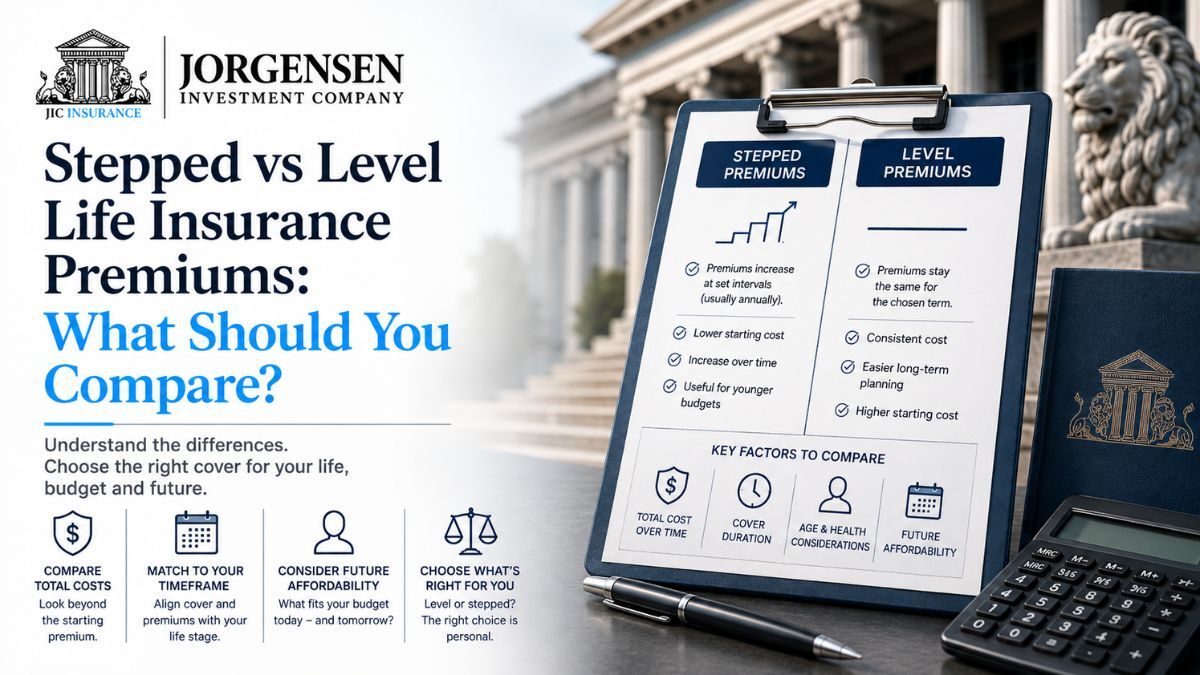
The main difference between stepped and level life insurance premiums is how your age affects the cost of your cover.
Stepped premiums generally start lower but are recalculated as you get older. Level premiums generally start higher, but future increases are not based on your increasing age.
However, that does not mean level premiums are fixed or guaranteed. Both premium structures can change for reasons such as insurer repricing, changes to your cover, indexation or the removal of discounts.
When comparing stepped and level life insurance premiums, the most important question is not simply which one is cheaper today. You need to compare:
- The starting premium.
- How long you realistically expect to retain the cover.
- The projected premiums over that period.
- Your likely insurance needs in the future.
- Whether you expect to reduce your cover as debts and financial responsibilities change.
- What other factors can increase the premium.
- The total cost under each structure, using the same cover and assumptions.
This article provides general information only. The appropriate premium structure will depend on your circumstances and intended approach to insurance.
What Is the Difference Between Stepped and Level Premiums?
The life insurance industry now commonly uses the terms "variable age-stepped premiums" and "variable premiums".
These replace the traditional terms "stepped" and "level". The newer language is intended to make it clearer that neither type of premium is guaranteed to remain unchanged.
|
Premium structure |
How it generally works |
Initial cost |
What may happen over time |
|
Variable age-stepped premium |
The premium is recalculated at each renewal based partly on your age. |
Generally lower |
The premium will generally rise as you get older and may also change for other reasons. |
|
Variable (level) premium |
The premium starts higher, but increases are not based on your increasing age. |
Generally higher |
Premiums may increase more slowly, but can still change because of insurer repricing, indexation and other policy factors. |
MoneySmart explains that variable age-stepped premiums are recalculated at each renewal based on age. Variable premiums charge more at the beginning, but changes are not based on age and therefore generally occur more slowly. MoneySmart also warns that neither structure is guaranteed and premiums may change annually. MoneySmart: Life insurance cover
For simplicity, this article continues to use "stepped" and "level" because these are the terms many Australians recognise and search for.
Do Level Life Insurance Premiums Stay the Same?
No. This is one of the most important points to understand when comparing stepped and level life insurance premiums.
A level premium generally means that your premium does not increase simply because you have become one year older. It does not necessarily mean the dollar amount you pay will remain level.
Premiums may still change because of:
- Insurer-wide changes to base premium rates.
- Automatic indexation increasing your sum insured.
- Changes you make to your cover.
- Discounts ending or changing.
- Policy fees and government charges.
- Other changes permitted under the policy terms.
APRA and ASIC found that consumers with level premiums were often under the mistaken impression that their premiums could not change. This contributed to the industry adopting "variable premium" in place of "level premium". APRA: Premium increases in life insurance
This means a comparison showing level premiums as a completely flat line and stepped premiums continually rising may create an unrealistic expectation.
Why Can Level Premiums Have a Stronger Argument When You Are Younger?
The argument for level premiums can be stronger when someone establishes cover at a young age and genuinely expects to keep it for a long time.
This is not because age 25 is a formal cutoff. It is because establishing the policy earlier may provide:
- A lower age-based starting point than applying later.
- More time for the slower premium structure to become valuable.
- A longer period over which to absorb the higher initial premium.
- Greater potential protection against future age-based increases.
However, the trade-off is that younger people often have a lower immediate need for life insurance.
Someone in their early 20s may not yet have:
- A mortgage.
- A spouse who depends on their income.
- Children.
- Significant household expenses.
- Business debts or financial obligations.
They may therefore pay the higher initial cost of a level premium for several years before their need for substantial cover develops.
There is also no guarantee that the original policy, cover amount or premium structure will still match their circumstances 10 or 20 years later.
Founder’s Perspective: Establishing Level Cover at 24
I was fortunate enough to establish my own policy at age 24 on a level premium. I was working in the insurance industry at a young age, so I understood the potential long-term value before I had the major life events that normally cause people to think seriously about life insurance.
Today, at 37, I could not replace that same policy with a new stepped-premium policy for the same cost. However, if I had not worked in the industry, I probably would not have considered the need for substantial cover until I was around 34, married, carrying a mortgage and raising children. Starting a level premium at that point would have been considerably more expensive.
The other side of the decision is that my insurance need was much lower at 24. I paid premiums for many years before I had the same level of financial responsibility that I have today.
That is the real trade-off. Starting younger can make level premiums more attractive over a long period, but it can also mean paying more upfront when your immediate need for cover is lower and your future requirements remain uncertain.
Why Are Stepped Premiums Commonly Chosen?
Stepped premiums are often chosen because they make it more affordable to establish a larger amount of cover today.
That can be valuable when someone has recently:
- Purchased a home.
- Taken on a large mortgage.
- Married or combined finances.
- Had children.
- Started a business.
- Become the main income earner for their household.
At these points, the immediate need for insurance may be high while household cash flow is already under pressure.
The person may also expect their need for cover to reduce over time. For example:
- More of the mortgage may be repaid.
- Savings and investments may grow.
- Children may become less financially dependent.
- Superannuation balances may increase.
- The household may become better positioned to fund part of the risk from its own assets.
Under this approach, someone may accept that stepped premiums will rise and plan to review and progressively reduce their sum insured as their need for external protection falls.
This should not be treated as an automatic strategy. A person’s debts, health, family responsibilities and financial position may not develop as expected. Reducing cover purely because the premium has increased could leave an unintended shortfall.
What Should You Compare?
1. The Cost Today
Start by comparing the first-year premium under each structure.
Stepped premiums will generally be cheaper initially. This may allow someone to obtain a higher amount of cover while managing their current cash flow.
However, the lowest first-year premium does not necessarily represent the lowest long-term cost.
2. The Projected Cost Over Time
Ask for premium projections covering the period you may realistically retain the policy.
Depending on your timeframe, that might mean comparing estimated premiums over:
- Five years.
- Ten years.
- Fifteen years.
- Twenty years or longer.
Compare both the annual premium and the cumulative amount paid.
These projections are illustrations based on current assumptions. They are not guarantees of what either premium structure will cost in the future.
3. The Assumptions Used in the Projection
Two premium projections are only useful if they are prepared on a comparable basis.
Check whether both quotes use the same:
- Sum insured.
- Indexation assumptions.
- Smoker status.
- Occupation classification.
- Payment frequency.
- Policy fees.
- Discounts.
- Optional benefits.
- Ownership structure.
- Product features.
A quote with automatic indexation may appear to rise faster partly because the amount of cover is increasing each year.
4. How Long You Expect to Keep the Cover
Level premiums generally require a longer timeframe for the higher initial cost to become worthwhile.
If you cancel the policy, significantly reduce the cover or replace it before reaching that point, you may never receive the expected long-term benefit.
This is why the expected policy duration matters as much as your current age.
5. How Your Need for Cover May Change
Consider why you are taking out the insurance and when that financial need may reduce.
Someone seeking cover primarily to repay a mortgage may expect their required sum insured to fall as the loan is repaid. Someone wanting to provide long-term support for a dependant may have a different timeframe.
Your future cannot be predicted precisely, but comparing several realistic scenarios can be more useful than assuming the same sum insured will remain appropriate indefinitely.
6. Your Ability to Afford the Policy Later
An insurance policy only remains useful while it can be retained.
A stepped premium that is manageable today may become difficult to afford later. A level premium may create greater pressure on cash flow in the early years.
The comparison therefore needs to consider both current affordability and the likelihood that the policy can remain affordable over the intended timeframe.
7. Factors Other Than Age
Do not compare premium structures as though age is the only reason premiums change.
APRA and ASIC have previously observed that insurers may reprice premiums because of factors including claims experience, policy lapses, economic conditions, assumptions and reinsurance arrangements. They also found that base-rate increases for level premiums were not necessarily lower than increases for stepped premiums. APRA and ASIC joint letter on premium increases
This is why "level" should never be interpreted as "guaranteed".
8. The Policy, Not Just the Premium Structure
Premium structure is only one part of a life insurance comparison.
You should also understand:
- What events the policy covers.
- The policy definitions.
- Any exclusions or special terms.
- Whether benefits are linked or stand-alone.
- How indexation operates.
- When the cover expires.
- How the insurer may change premium rates.
- The insurer’s claims statistics.
- The relevant Product Disclosure Statement and Target Market Determination.
A cheaper premium structure may not provide better value if the policy itself does not offer the features being compared.
Stepped vs Level Premiums: A Practical Comparison
|
Consideration |
Stepped premiums may be worth comparing when... |
Level premiums may be worth comparing when... |
|
Starting cost |
Keeping the initial premium lower is important. |
A higher initial premium is manageable. |
|
Intended timeframe |
The expected need may be shorter or reduce materially. |
The cover is expected to remain in place for a long time. |
|
Age at application |
Cover is being established later or for a defined need. |
Cover is being established young with a long intended duration. |
|
Future cover needs |
There is a plan to review and reduce cover as liabilities fall. |
A substantial amount of cover may be required for an extended period. |
|
Cash-flow preference |
Lower cost today is prioritised. |
Greater stability from age-related increases is prioritised. |
|
Main risk |
Premiums may become difficult to afford later. |
The policy may be cancelled before the higher early cost delivers value. |
These are general comparison points, not rules about which structure a particular person should select.
Is There a Guaranteed Break-Even Point?
No.
A quote may show an estimated point where the annual stepped premium becomes higher than the level premium. It may also show when the cumulative amount paid under level premiums becomes lower.
However, that crossover point can change because:
- The insurer reprices one or both premium structures.
- Your sum insured changes.
- Indexation is applied or removed.
- Discounts change.
- You reduce or cancel part of the cover.
- The policy does not remain in force for as long as expected.
The crossover point should be treated as a projection, not a guaranteed outcome.
Should You Plan to Reduce Stepped Cover Over Time?
Some people take out stepped premiums with the intention of reducing their cover as they become more able to self-insure.
In this context, self-insuring means using your own financial position to absorb more of the risk. This could include having:
- A smaller mortgage.
- More savings and investments.
- A larger superannuation balance.
- Older and less financially dependent children.
- Lower household expensese
This can be a logical factor to compare, but the reduction should be based on the amount of cover still required - not simply the desire to stop the premium from rising.
If your circumstances materially affect the decision, speak with a JIC financial adviser
How JIC Insurance Can Help You Compare
JIC Insurance allows Australians to compare life insurance options from a panel of leading insurers.
The comparison can help you assess:
- Stepped and level premium options where available.
- Current quoted premiums.
- Available product features.
- Insurer claims statistics.
- Policy ownership options.
- Relevant insurer and product information.
JIC Insurance provides general information and application support. You remain responsible for deciding which option you would like to apply for.
Frequently Asked Questions
Are level life insurance premiums guaranteed not to increase?
No. Level premiums are not generally guaranteed. They do not increase because of your age in the same way as stepped premiums, but they may still change because of insurer repricing, indexation, policy changes, fees or changing discounts.
Are level premiums always cheaper over the long term?
No. The outcome depends on how long the policy remains in place, future premium changes, the amount of cover and whether the policy is reduced or cancelled. There is no guaranteed break-even point.
Are stepped premiums better if I expect to reduce my cover?
Stepped premiums may be worth comparing when someone expects their insurance need to fall as debts and financial responsibilities reduce. However, future needs may not develop as expected, so cover should be reviewed before it is reduced.
Can I change from stepped to level premiums later?
This depends on the insurer and policy. Changing the premium structure or replacing the policy may involve a new quote, an older entry age and potentially further underwriting. Check the applicable policy terms before making changes.
Does the premium structure change what the policy covers?
The premium structure primarily affects how the cost is calculated. The insured events, definitions, exclusions and benefits depend on the underlying policy. These features should be compared separately.
Should younger people automatically choose level premiums?
No. Starting young can strengthen the long-term argument for level premiums, but younger people may have a lower immediate need for cover and greater uncertainty about how long they will keep the policy. Both the current need and expected duration should be considered.
Compare Stepped and Level Life Insurance Premiums
Level premiums can have a stronger argument when cover is established young and expected to remain in place for a long time. Stepped premiums can make a higher amount of cover more affordable today and may align with a plan to reduce cover as debts and dependency fall.
The most useful comparison considers the cost today, projected premiums, total expected cost, future insurance needs and the realistic period for which the policy may be retained.
About the Author
Alex Jorgensen is the Founder of Jorgensen Investment Company (JIC), with over 10 years of experience in financial services. As the Responsible Manager he directly oversees compliance supervision and operations, focusing on creating simple, structured solutions that help clients make confident financial decisions. Alex is a registered provider on the official ASIC Financial Advisers Register. You can verify his independent client reviews on Adviser Ratings or connect with him via LinkedIn. Alex Jorgensen is a registered financial adviser for JIC Wealth AR # 001238139 under AFSL JIC Adviser Network AFSL # 562451.
General Advice Warning
This article contains general information only and does not take into account your personal objectives, financial situation or needs. This website provides general advice only and all information is general in nature. Before making a decision about any financial matters, you should consider whether the information is appropriate for your circumstances and read the relevant Product Disclosure Statement, Target Market Determination and Financial Services Guide. You may also wish to seek professional advice before deciding whether to apply for, change or cancel insurance cover.
.jpg?width=352&name=Blog%20What%20to%20look%20for%20before%20choosing%20life%20insurance%20-%20Thumb%20nail%20(1).jpg)
.jpg?width=352&name=Blog%20%20Compare%20Life%20Insurance%20Austraila%20-%20Thumb%20nail%20(1).jpg)

Leave a Comment