


.jpg)
A simple way to estimate your monthly benefit before getting quotes
When comparing Income Protection Insurance, one of the first questions people ask is:
“How much Income Protection do I actually need?”
Income Protection Insurance is designed to help replace part of your income if you are unable to work because of illness or injury, depending on the terms of your policy. Unlike Life Insurance, TPD Insurance or Trauma Insurance, Income Protection usually provides a regular monthly benefit rather than one lump sum payment.
A simple starting point is:
Monthly living expenses + debt repayments + family costs + recovery buffer − sick leave, savings and other income = estimated monthly Income Protection need
This is not personal advice, but it gives you a practical way to estimate the level of monthly benefit you may want to compare.
If you need help determining how much you should compare for other Life insurances, you might want to read these areticles next?
Read next: How Much Life Insurance Should I Compare?
Read next: How Much TPD Cover Should I Compare?
Read next: How Much Trauma Cover Should I Compare?
Once you have a rough number, the next step is to compare Income Protection Insurance options from a range of leading Australian insurers in minutes.
What is Income Protection Insurance designed to do?
Income Protection Insurance is designed to help protect your cash flow if you cannot work for a period of time because of illness or injury.
The purpose is usually to help you keep meeting regular expenses such as:
- mortgage or rent payments
- groceries and household bills
- school fees or childcare
- car loans and personal debts
- medical and recovery costs
- family living expenses
- business or self-employed income gaps
For many Australians, income is one of their most important financial assets.
Without income, even a strong financial position can come under pressure quickly.
That is why Income Protection can be especially important for people with:
- mortgages
- dependants
- limited sick leave
- self-employed income
- business income
- high ongoing expenses
- single-income households
- variable or commission-based income
Income Protection does not remove the illness or injury, but it may help reduce the financial pressure while you focus on recovery.
Income Protection vs Life, TPD and Trauma Insurance
It helps to understand how Income Protection fits alongside other types of personal insurance.
| Cover type | Main purpose |
|---|---|
| Life Insurance | May pay a lump sum if you pass away or are diagnosed with a terminal illness |
| TPD Insurance | May pay a lump sum if you become totally and permanently disabled and meet the policy definition |
| Trauma Insurance | May pay a lump sum if you suffer a specified serious illness or injury covered by the policy |
| Income Protection | May pay a regular monthly benefit if illness or injury prevents you from working for longer than the waiting period |
The key difference is that Income Protection is usually about replacing cash flow, not paying one large lump sum.
MoneySmart describes Income Protection as cover that can pay part of your lost income if you cannot work because of illness or injury.
A simple way to estimate Income Protection cover
When working out how much Income Protection Insurance you may need, consider five main areas:
- your monthly income
- your regular expenses
- your debts and family commitments
- your sick leave, savings and emergency funds
- your waiting period and benefit period
The right amount depends on your income, occupation, expenses, family situation, savings and how long you could manage without work income.
1. Your monthly income
The first question is:
How much of my income would I need replaced if I could not work?
Income Protection usually does not replace all of your income. Policies commonly limit the insured monthly benefit to a percentage of income, subject to the insurer’s rules, policy terms and underwriting requirements.
When estimating your needs, consider:
- your regular salary or business income
- whether your income varies month to month
- whether you receive bonuses or commissions
- whether your partner also earns income
- whether your household relies mainly on your income
- whether you are self-employed or employed
- whether your income is likely to change
For example, if you earn $100,000 per year, your gross monthly income is around $8,333 before tax.
You may not need that full amount replaced, but you should understand what monthly amount would help keep your household stable.
2. Your monthly expenses
The next step is to work out how much your household actually needs each month.
This may include:
- mortgage or rent
- groceries
- utilities
- insurance premiums
- transport costs
- school fees
- childcare
- medical costs
- phone and internet
- loan repayments
- general household spending
This gives you a clearer picture of the monthly amount you may need if your income stopped.
For example, if your household expenses are $6,000 per month, your Income Protection needs may be very different from someone whose essential expenses are $3,500 per month.
The goal is not necessarily to replace your lifestyle perfectly. The goal is to understand what monthly support may help keep your household financially stable while you recover.
3. Your debts and family commitments
Income Protection can become especially important when you have ongoing financial commitments.
These may include:
- home loan repayments
- investment property loans
- car loans
- personal loans
- credit cards
- school fees
- childcare costs
- family support obligations
- business expenses if self-employed
The key question is:
If I could not work for 6 months, 12 months or longer, what expenses would still need to be paid?
Unlike Trauma Insurance or TPD Insurance, Income Protection may not clear a debt in one lump sum. Instead, it may help you keep meeting repayments while you recover.
4. Your sick leave, savings and emergency funds
You should also consider what support you already have available.
This may include:
- paid sick leave
- annual leave
- emergency savings
- offset account funds
- partner’s income
- investment income
- Trauma Insurance
- other personal insurance
If you have a strong emergency fund and significant paid leave, you may be able to choose a longer waiting period or require less immediate support.
If you have limited savings, are self-employed, or have no paid sick leave, Income Protection may be more important.
5. Waiting period and benefit period
Two of the most important features of Income Protection are the waiting period and the benefit period.
The waiting period is how long you need to be unable to work before a benefit may become payable.
The benefit period is how long the monthly benefit may continue if you remain eligible to claim.
MoneySmart notes that most Income Protection policies offer waiting periods between 14 days and two years, and that the waiting period is one of the key policy features to check before applying.
A shorter waiting period may provide support sooner, but it may also cost more.
A longer waiting period may reduce premiums, but you need enough savings or leave to cover the gap.
When choosing a waiting period, ask:
How long could I comfortably pay my bills without income?
When choosing a benefit period, ask:
How long would I want support if I had a serious illness or injury and could not return to work?
If you need help determing how much insurance cover you need, check out the JIC Insurance needs calculator.
Simple Income Protection calculation example
Here is a simple example of how someone might estimate their Income Protection needs before comparing quotes.
| Item | Monthly Amount |
|---|---|
| Mortgage repayments | $3,200 |
| Groceries and household bills | $1,800 |
| School fees and family costs | $900 |
| Car loan and other debts | $600 |
| Medical and recovery buffer | $500 |
| Partner’s available income contribution | -$1,500 |
| Estimated monthly income need | $5,500 |
| Add back estimated tax* | $1,500 |
| Total Income Protection Sum Insured | $7,000 |
In this example, the person may want to compare Income Protection options around $7,000 per month, depending on policy limits, insurer rules and their personal circumstances.
*IMPORTANT NOTE: Remember that income protection can be taxed, the same way your regular income is. Therefore, you may want to account for this. Once you have calculated your need you could use an after tax income tax calculator like this one available at MoneySmart. Play with the your income number, until your after tax calculator reflect your estimated monthly income need as seeb below for this example, the add back for estimated taxes would be about $1,500.
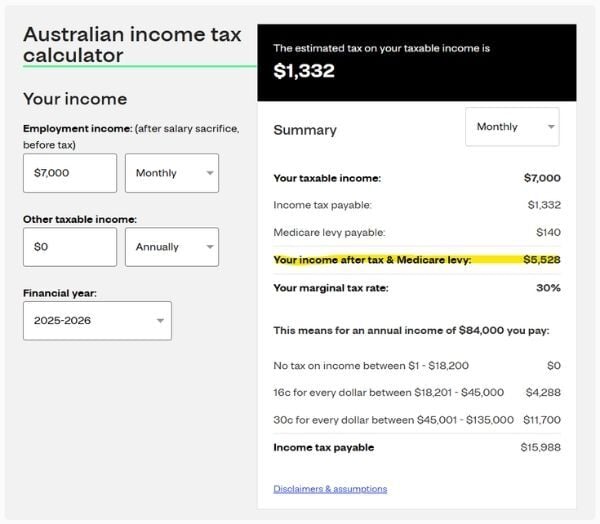
This does not mean everyone needs this amount. Your own figure may be higher or lower depending on your income, expenses, family situation, savings, occupation and existing cover. This is not an extensive list of what might be important to you, you should therefore assess whats important to you when calculating your sum insured and the above example, is just an example, not a definitive method for calculation.
If you know how much income protection insurance you would like, you can compare a range of insurers with the JIC Insurance comparison and Quote tool.
Is Income Protection through super enough?
Some Australians hold Income Protection Insurance through their superannuation fund.
This can be convenient because premiums may be paid from your super balance rather than your personal cash flow.
MoneySmart notes that Income Protection inside super, also called salary continuance cover, may pay a regular income for a set time if you cannot work because of illness or injury. This could be for two years, five years or up to a certain age, depending on the policy.
However, it is important to check whether the cover actually suits your needs.
You should consider:
- the monthly benefit amount
- the waiting period
- the benefit period
- the policy definition
- whether cover continues if you change super funds
- whether premiums reduce your retirement savings
- whether the policy has the features you need
- whether the cover matches your occupation and income
AFCA notes that to claim Income Protection benefits in superannuation, you need to show the insurer that you are eligible under the policy, including meeting the relevant definition of total disability.
Income Protection through super may be suitable for some people, but it should not be assumed to be enough without reviewing the details. Policies outside of superannuation, do not need to meet the conditions of release of a superannuation fund. They are dependent on the definitions of the insurer and policy.
Is Income Protection important if you are self-employed?
Income Protection can be especially important for self-employed people.
If you run your own business, you may not have paid sick leave or employer support. If you cannot work, your income may stop quickly, while business and household expenses continue.
Self-employed people may need to consider:
- variable income
- business overheads
- personal living costs
- debt repayments
- family expenses
- how long the business could operate without them
- whether another person could step in temporarily
- how the insurer calculates pre-disability income
For business owners, Income Protection is not only about protecting income. It can also help protect household stability while you recover.
Are Income Protection premiums tax deductible?
Income Protection can also have tax considerations.
The ATO states that only the premiums you pay to protect your income, such as salary and wages, are deductible. This is generally known as Income Protection or continuing salary cover.
The ATO also states that Income Protection insurance payments must generally be declared as income, depending on how the policy is owned and paid.
This is one reason it is important to consider how the cover is structured before applying.
You should speak with a qualified tax adviser or financial adviser if you are unsure how the tax treatment applies to your situation. If you are looking for a qualified financial adviser to assist you, you can book a meeting directly with Alex Jorgensen at JIC Wealth here.
Why policy features matter when comparing Income Protection
When comparing Income Protection, price is only one part of the decision.
You may also want to compare:
- monthly benefit amount
- waiting period
- benefit period
- occupation category
- income definition
- pre-disability income calculation
- exclusions
- offsets
- premium type
- ownership structure
- whether cover is inside or outside super
- claims process
- insurer strength and service
APRA publishes life insurance claims and disputes statistics on a biannual basis, including industry and insurer-level data. This information is also used to support consumer-facing information through MoneySmart. The JIC Insurance comparison tool will also produce a detailed comparison report that includes key statistics like these for you to help with making an informed decision.
That does not mean you should choose a policy based only on claims statistics, but it reinforces why insurer, product terms and claims handling are worth considering alongside price.
Common mistakes when comparing Income Protection
1. Assuming “it won’t happen to me”
Many people underestimate the financial impact of being unable to work due to illness or injury.
Even a few months without income can place pressure on savings, mortgage repayments and family finances.
Income Protection is designed to help reduce that cash-flow risk.
2. Choosing a waiting period without checking savings
A longer waiting period may reduce premiums, but it only works if you can afford to fund the gap yourself.
For example, if you choose a 90-day waiting period, you need to consider whether you could comfortably cover three months of expenses without income.
If you do not have enough sick leave or savings, a long waiting period may create a problem at claim time.
3. Only looking at the premium
Cost matters, but the cheapest policy is not always the most appropriate.
You should also consider:
- waiting period
- benefit period
- policy definitions
- exclusions
- premium structure
- occupation class
- ownership structure
- how the cover fits your needs
The goal is not simply to find the cheapest Income Protection policy. The goal is to compare options that match your income, expenses and risk.
4. Forgetting about tax and cash flow
Income Protection premiums and claim payments can have tax implications.
If you are comparing personally owned Income Protection, it is worth understanding whether premiums may be deductible and how claim payments may be treated.
The ATO provides guidance on Income Protection deductions and payments, but you should seek tax advice if you are unsure.
5. Not reviewing cover over time
Your Income Protection needs can change.
You should consider reviewing your cover when you:
- change jobs
- start or sell a business
- increase your income
- take on a mortgage
- have children
- reduce your debts
- build savings
- change super funds
- review your broader financial plan
The cover that suited you several years ago may not suit your current circumstances.
Quick Income Protection checklist
Before comparing Income Protection cover, ask yourself:
- How much income does my household rely on?
- What are my essential monthly expenses?
- How long could I survive without income?
- How much sick leave do I have?
- How much emergency savings do I have?
- Does my partner earn income?
- What waiting period could I afford?
- What benefit period would I want?
- Do I have Income Protection through super?
- Am I self-employed or relying on variable income?
- When did I last review my cover?
If you cannot answer these clearly, it may be worth comparing your options.
Frequently Asked Questions
How much Income Protection Insurance do I need?
A simple starting point is to estimate your essential monthly expenses, debt repayments, family costs and recovery buffer, then subtract sick leave, savings and other reliable income.
The right amount depends on your income, expenses, occupation and personal circumstances.
Is Income Protection the same as Life Insurance?
No. Life Insurance generally pays a lump sum if you pass away or are diagnosed with a terminal illness.
Income Protection generally pays a monthly benefit if you cannot work due to illness or injury and meet the policy terms.
Is Income Protection the same as TPD Insurance?
No. TPD Insurance generally pays a lump sum if you become totally and permanently disabled and meet the policy definition.
Income Protection may provide monthly payments if you are temporarily or permanently unable to work, depending on the policy terms.
Do I need Income Protection if I have Trauma Insurance?
Possibly. Trauma Insurance and Income Protection solve different problems.
Trauma Insurance may provide a lump sum for specified serious medical events, while Income Protection may provide monthly income support if you cannot work due to illness or injury.
Some people may benefit from having both.
Can I have Income Protection through super?
Yes. Some people hold Income Protection through super.
However, you should check the benefit amount, waiting period, benefit period, definitions, ownership structure and whether the cover suits your needs.
What waiting period should I choose?
The right waiting period depends on how long you could afford to be without income.
If you have limited savings or paid leave, a shorter waiting period may be worth considering.
If you have strong savings, you may be comfortable with a longer waiting period.
Are Income Protection premiums tax deductible?
The ATO states that premiums paid to protect your income, such as salary and wages, are generally deductible. However, tax treatment can depend on ownership and structure, so you should consider seeking tax advice.
When should I review my Income Protection Insurance?
You should consider reviewing your Income Protection when your income, job, business, debts, family situation, savings or financial goals change.
An annual review can also be a sensible starting point.
Ready to compare Income Protection Insurance options?
Once you have a general idea of how much Income Protection Insurance you may need, the next step is to compare your options.
Different insurers may offer different premiums, waiting periods, benefit periods, policy features and underwriting requirements.
JIC Insurance can help you compare Income Protection Insurance options from a range of Australian insurers, with support available if you need help understanding your options.
About the Author
Alex Jorgensen is the Founder of Jorgensen Investment Company (JIC), with over 10 years of experience in financial services. As the Responsible Manager he directly oversees compliance supervision and operations, focusing on creating simple, structured solutions that help clients make confident financial decisions. Alex is a registered provider on the official ASIC Financial Advisers Register. You can verify his independent client reviews on Adviser Ratings or connect with him via LinkedIn. Alex Jorgensen is a registered financial adviser for JIC Wealth AR # 001238139 under AFSL JIC Adviser Network AFSL # 562451.
General Advice Warning
This article contains general information only and does not take into account your personal objectives, financial situation or needs. This website provides general advice only and all information is general in nature. Before making a decision about any financial matters, you should consider whether the information is appropriate for your circumstances and read the relevant Product Disclosure Statement, Target Market Determination and Financial Services Guide. You may also wish to seek professional advice before deciding whether to apply for, change or cancel insurance cover.
Our Sources:
- MoneySmart - Income Protection Insurance
- MoneySmart - Insurance Through Super
- Australian Taxation Office - Income Protection Insurance
- Australian Taxation Office - Income Protection Insurance Payments
- Australian Prudential Regulation Authority - Life Insurance Claims and Disputes Statistics
- Australian Financial Complaints Authority - Income Protection Benefits in Superannuation
- Australian Securities and Investments Commission - RG 274 Product Design and Distribution Obligations
- Council of Australian Life Insurers - The Life Code
.jpg?width=352&name=How%20Much%20Trauma%20Cover%20Should%20I%20compare%20-%20Thumb%20nail%20(1).jpg)
.jpg?width=352&name=Blog%20How%20Does%20Income%20Protection%20Insurance%20Work%20in%20Australia%20-%20Thumb%20nail%20(1).jpg)
.jpg?width=352&name=Blog%20Post%204%20-%20Thumb%20nail%20(1).jpg)
Leave a Comment