



Comparing Life Insurance Quotes
Comparing life insurance quotes can be a helpful first step when you are thinking about protecting your family, your mortgage, or the people who rely on your income.
But comparing life insurance is not only about finding the lowest premium.
A quote can help you see how different cover amounts, insurers and policy structures may affect your premium. It can also help you understand whether the cover you are considering fits your budget before you apply.
Life cover, also known as term life insurance or death cover, pays a lump sum if the insured person passes away. MoneySmart explains that people who rely on your income may use this money to help pay the mortgage, clear debts and cover everyday costs.
Ready to compare?
Start a life insurance comparison with JIC Insurance and see what options may be available based on the details you provide.
Key points
- Life insurance quotes can vary between insurers.
- Your age, health, job, lifestyle, smoking status and cover amount may affect the premium.
- Comparing premiums is important, but it is also worth checking policy features, exclusions, ownership structure and claims information.
- Life insurance may be held inside superannuation or outside superannuation.
- A quote comparison can help you understand available options before deciding whether to apply.
Why compare life insurance quotes before applying?
Life insurance is not a one-size-fits-all product.
Two people may compare the same amount of cover and receive different premiums because their personal details are different. The same person may also receive different quotes from different insurers because each insurer has its own pricing, policy features and assessment process.
MoneySmart notes that insurers set premiums based on factors such as age, health, job and lifestyle, and that premiums generally rise as a person gets older.
That is why comparing quotes before applying can be useful. It can help you see:
- what premium range may apply,
- how different cover amounts affect the cost,
- whether cover may be available inside or outside superannuation,
- how different insurers compare,
- what features may be included or excluded,
- whether the premium may fit your budget, and
- whether you want to continue to the application stage.
A comparison does not lock you into applying. It gives you a clearer starting point.
What does a JIC Insurance comparison show?
When you complete a life insurance comparison with JIC Insurance, the comparison may show more than just a monthly price.
Depending on the details provided and the cover being compared, your comparison may include:
- available insurer options,
- estimated monthly premiums,
- superannuation and non-superannuation premium options where available,
- the cover amount being compared,
- whether the premium structure is stepped,
- a breakdown of life cover, TPD extension and policy fees where applicable,
- product feature comparisons,
- insurer information,
- product strengths,
- product limitations,
- Product Disclosure Statement details,
- insurer claims information,
- average claim processing times, and
- dispute information where available.
This matters because a cheaper quote is not always the only thing worth considering. A comparison report can also show differences in features and policy details. For example, the sample comparison report you provided includes policy names, monthly premium columns, feature and combined score fields, and notes that combined scores are evaluated using both features and price.
That gives the comparison more context than a simple list of prices.
What information do you need to compare life insurance quotes?
To compare life insurance quotes, you will usually need to provide some basic information.
This may include:
- your age,
- gender,
- smoking status,
- occupation,
- income,
- general health details,
- lifestyle details,
- cover amount,
- whether you want cover inside or outside super, and
- whether you want life cover only or additional cover types included.
MoneySmart explains that life insurers usually ask about age, job, medical history, family health history, smoking, lifestyle and high-risk hobbies or sports when assessing life cover.
It is important to provide accurate information. If key details are left out or answered incorrectly, it may affect the application, policy terms or future claim.
What to check when comparing life insurance quotes
A life insurance comparison can help you review several important areas before applying.
1. Cover amount
The cover amount is the lump sum that would be paid if a valid claim is accepted.
Many people compare life insurance because they want cover that may help with:
- paying out a mortgage,
- clearing debts,
- replacing income for a period of time,
- supporting a partner,
- helping with children’s education costs,
- covering funeral expenses, or
- giving the family time to adjust financially.
The higher the cover amount, the higher the premium is generally likely to be. Comparing different cover amounts may help you see how your premium changes as the level of protection changes.
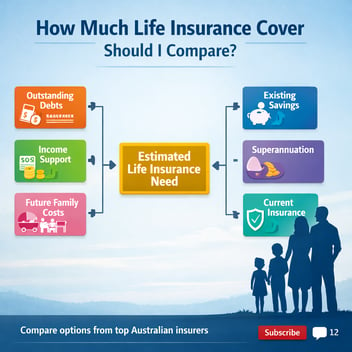
Not sure what amount to compare?
You may wish to start with your mortgage, debts, income replacement needs and family expenses, then compare quotes at different cover levels.
2. Estimated premium
The premium is the cost of the insurance.
When comparing quotes, make sure you are comparing the same payment frequency, such as monthly or annually. Also check whether the quoted premium is for the same cover amount, same cover type and same ownership structure.
MoneySmart notes that life insurance premiums are not guaranteed and may change over time.
When reviewing premiums, it may be useful to ask:
- Is the premium affordable now?
- Could the premium become harder to manage later?
- Is the premium based on the same cover amount as the other quotes?
- Is the quote inside super or outside super?
- Are there policy fees included?
- Is the comparison showing life cover only, or life cover with other benefits attached?
A quote can help you compare cost, but the final premium and policy terms are subject to insurer assessment.
3. Ownership structure: inside or outside super
Life insurance may be held inside superannuation or outside superannuation.
MoneySmart notes that most super funds offer insurance through super, including life cover, TPD and income protection.
If cover is held inside super, premiums are generally deducted from your super balance. This may help with personal cashflow because the premium is not paid directly from your bank account, but it also reduces retirement savings over time.
When comparing life insurance, it may be worth checking:
- whether you already have cover through super,
- how much cover you already have,
- what the premium is,
- when the cover ends,
- whether the cover amount is enough,
- whether duplicate cover exists across multiple funds, and
- whether cover outside super may also be available.
This is one reason a comparison should not be viewed as only a price check. The ownership structure may also matter.
4. Policy features
Different insurers may offer different features.
Your comparison may show product features such as:
- terminal illness benefit,
- financial planning benefit,
- premium waiver on disability,
- premium freeze option,
- funeral expenses benefit,
- severe trauma benefit,
- counselling benefit,
- loyalty benefit,
- cover suspension options,
- conversion options,
- TPD extension features, and
- TPD-related benefits where applicable.
The sample comparison report you provided includes a feature similarities and differences section that compares life and TPD features across insurers, including items such as premium waiver, funeral expenses benefit, counselling benefit, premium freeze option and TPD conversion options.
This can help show that two policies with similar premiums may still have different benefits, limitations and product structures.
5. Product strengths and limitations
A useful comparison should help you understand both the positives and the limitations of each option.
For example, one policy may include a certain benefit that another does not. Another policy may have a higher premium but include features that are relevant to the type of cover being compared.
The comparison report you provided shows insurer-specific sections that include Product Disclosure Statement details, key statistics, product strengths and product limitations.
This is important because life insurance should not be compared on price alone.
When reviewing a comparison, it may be useful to check:
- What benefits are included?
- What benefits are not included?
- Are there exclusions or limitations?
- Is there a policy fee?
- Is the PDS current?
- Are the quoted features relevant to the cover type being compared?
6. Insurer claims information
Price and features are important, but claims information may also be useful.
MoneySmart provides a life insurance claims comparison tool that lets consumers see the percentage of claims an insurer pays, how long an insurer takes to pay a claim, and the number of disputes lodged about claims with an insurer.
APRA publishes life insurance claims and disputes statistics twice a year, and a consumer-friendly selection of that data is also made available through ASIC’s MoneySmart website.
This information does not replace reading the Product Disclosure Statement, but it can add useful context when comparing insurers.
Is the cheapest life insurance quote always better?
Not always.
A cheaper quote may look attractive, but price is only one part of the comparison.
A lower premium may come with different features, definitions, limitations, policy fees, ownership structure or future premium changes. Another policy may cost more but include different benefits or product features.
When comparing quotes, it may be useful to look at the full picture:
- What cover amount is being compared?
- What premium is being quoted?
- Is the cover inside or outside super?
- Are there policy fees?
- What features are included?
- What limitations apply?
- What does the PDS say?
- What claims information is available?
- Is the quote only an illustration?
- Is insurer approval still required?
The aim is not simply to find the cheapest quote. The aim is to understand the options available before deciding whether to apply.
What happens after you compare life insurance quotes?
After comparing quotes, you can decide whether you want to continue.
The process may look like this:
1. Compare options
You enter your details and compare available life insurance options.
2. Review the comparison
You review the estimated premiums, cover amount, insurer options, ownership structure, product features and key policy information.
3. Decide whether to apply
If an option appears worth exploring, you can continue to the application stage.
4. Complete insurer questions
One of our JIC Insurance representatives will reach out after your comparison and help you complete the insurers application if you would like. The insurer may ask more detailed questions about health, medical history, family history, occupation, lifestyle and hobbies.
5. Insurer assessment
The insurer assesses the application. Depending on the information provided, they may offer standard terms, request more information, apply a premium loading, apply an exclusion or decline the application.
6. Policy decision
Once the insurer provides an outcome, you can decide whether to proceed.
Important: a quote / comparison is not an offer of insurance
A life insurance comparison is an illustration only.
The premiums and policy fees shown in a comparison are not guaranteed. They are based on the personal information supplied at the date of the illustration, the benefit levels selected, and the insurer’s pricing at that time. Premiums may change in the future.
The illustration is not an offer of insurance, and that premiums and other values are subject to approval by the relevant insurance company after a completed application form is received. The relevant Product Disclosure Statement should be reviewed for full details of the insurance offered and the terms and conditions that apply.
That is why the comparison stage is best understood as a starting point, not the final approval.
Why compare with JIC Insurance?
JIC Insurance helps Australians compare life insurance options through a simple, professional process.
Instead of contacting insurers one by one, you can use our comparison process to review available options and decide whether you want to continue.
With JIC Insurance, you can compare:
- estimated premiums,
- available insurer options,
- cover amounts,
- super and non-super ownership options where available,
- policy features,
- product strengths,
- product limitations,
- PDS details, and
- insurer claims information where available.
Start a life insurance comparison with JIC Insurance today.
Review available options and decide whether you want to apply.
Final checklist before applying
Before applying for life insurance, it may be useful to check:
- the cover amount,
- the estimated premium,
- whether cover is inside or outside super,
- whether you already have existing cover,
- whether there are policy fees,
- the policy features,
- the product limitations,
- the Product Disclosure Statement,
- insurer claims information,
- whether the application details are accurate, and
- whether the quote is still current.
A comparison can help you move from guessing to understanding the options available.
Need help deciding how much Life insurance? Read our article here
Or, Do you want to understand what impacts the price of life insurance? Read our article here
Start your comparison with JIC Insurance and take the next step.
General information disclaimer
This article contains general information only and does not take into account your objectives, financial situation or needs. Before making a decision, consider whether the information is appropriate for you and read the relevant Product Disclosure Statement. Any application for insurance is subject to assessment and approval by the relevant insurer.

Leave a Comment